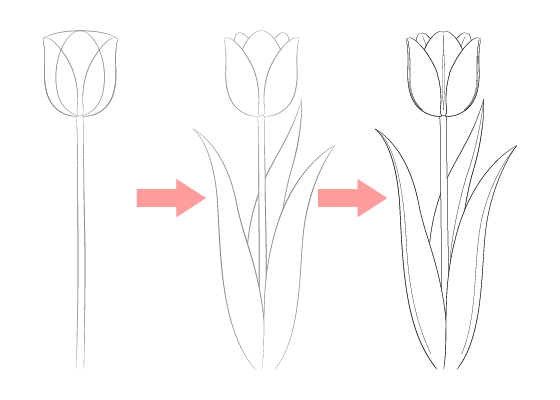
Easy step-by-step drawing tutorials serve as the perfect entry point for anyone who has ever looked at a blank piece of paper and felt a wave of intimidation. Many of us grew up believing that artistic talent is a magical gift bestowed at birth, yet the truth is far more grounded in practice, patience, and the right guidance. I remember sitting at my kitchen table years ago, clutching a simple HB pencil and trying to draw a bowl of fruit. It looked more like a collection of lopsided rocks than a still life, and I almost walked away from the hobby entirely. It was only when I found a guide that broke down complex shapes into manageable segments that the world of art finally opened up for me.
The journey of an artist does not begin with a masterpiece; it starts with a single, humble line. When you approach a new subject, the brain often tries to process the entire image at once, which leads to mental overwhelm and physical hesitation. By utilizing a structured approach, you effectively tell your brain to slow down and focus on one specific curve or angle at a time. This methodical breakdown is the secret behind why most professional artists can tackle immense projects without losing their sense of proportion or detail. It is about deconstructing the visual world and rebuilding it on your own terms.
One of the most profound shifts in my own artistic journey happened when I realized that every object in the universe is composed of basic geometric shapes. A tall skyscraper is just a series of rectangles, and a human face is a complex arrangement of ovals and triangles. When you start to see the world through this lens, the act of drawing becomes less about “copying” and more about “constructing.” This shift in perspective is exactly what a well-crafted tutorial provides. It gives you the blueprint so that you can focus on the craftsmanship rather than the confusion of where to start.
The psychology behind Easy step-by-step drawing tutorials
There is a specific psychological comfort that comes with following a guide that has a clear beginning, middle, and end. In our daily lives, we are often bombarded with open-ended tasks that have no clear resolution. Engaging with a creative process that guarantees progress through specific stages provides a much-needed sense of control and accomplishment. This is particularly important for adult learners who might be more self-critical than children. Having a roadmap allows you to silence the inner critic and simply follow the directions provided by the instructor.
Furthermore, the act of drawing is a deeply meditative experience that requires a unique form of “active” concentration. When you are following a tutorial, your mind enters a flow state where the worries of the day begin to fade into the background. You are no longer thinking about your mortgage or your car’s engine light; you are only thinking about the relationship between the eye and the bridge of the nose on your paper. This mental clarity is a secondary benefit that many people find even more valuable than the drawing itself. It becomes a form of therapy that leaves you with a physical artifact of your time spent in peace.
I often tell my students that the first ten drawings they do will probably be terrible, and that is perfectly okay. In fact, it is necessary. Every “bad” drawing is a lesson in what not to do next time. The beauty of a structured guide is that it helps you navigate these early failures more quickly. Instead of spending hours struggling with a specific perspective, you can see how someone else solved that problem and apply their logic to your own work. It is like having a mentor sitting next to you, gently nudining your hand in the right direction when you start to veer off course.
Why most beginners need Easy step-by-step drawing tutorials
The primary reason people give up on drawing is the gap between their “taste” and their “skill.” We all know what a good drawing looks like, and when our hands cannot replicate what our eyes see, we feel a sense of frustration. This gap can be bridge through the use of high-quality instructional material. A good tutorial doesn’t just show you what to draw; it explains why you are drawing it. It teaches you about the weight of the line, the direction of the light, and the importance of negative space. These are the building blocks of visual literacy.
When I first started teaching art, I noticed that students who tried to draw from their imagination too early often became discouraged. They were trying to build a house without a foundation. By using a guide, you are essentially borrowing the foundation of a more experienced artist while you build your own skills. Over time, you will find that you need the guides less and less. You will start to recognize the patterns and the structures on your own, and that is the moment when you truly become an artist. The guide is a ladder, not a permanent crutch.
Consistency is another area where these tutorials prove their worth. It is much easier to commit to a twenty-minute drawing session when you know exactly what you are going to work on. The “blank page syndrome” is a real productivity killer. If you sit down with a pencil but no plan, you are likely to spend fifteen minutes scrolling through your phone looking for inspiration and only five minutes actually drawing. A pre-selected tutorial removes the decision fatigue and allows you to get straight to the creative work.
The tactile sensation of drawing is something that cannot be replicated by digital shortcuts. There is a specific feedback loop between the grain of the paper and the lead of the pencil that helps develop fine motor skills. As you follow a guide, you are also training your hand-eye coordination. You are learning exactly how much pressure to apply to get a light, feathery stroke versus a bold, dark one. This physical mastery is a slow process, but it is incredibly rewarding when you finally feel the pencil becoming an extension of your own thoughts.
In the digital age, many people are turning toward Easy step-by-step drawing tutorials as a way to disconnect from screens. Even if you are watching a video tutorial, the act of looking away from the screen to your physical paper provides a necessary break for your eyes and mind. It is a way to reclaim a bit of our analog humanity in an increasingly virtual world. There is something deeply grounding about having graphite on your fingers at the end of a long day. It feels like real work in a way that typing on a keyboard never quite does.
For those who feel they have no “natural” ability, I would point to the history of the great masters. Leonardo da Vinci and Michelangelo did not just wake up one day and paint the Sistine Chapel. They spent years as apprentices, copying the works of their teachers and following rigorous, step-by-step instructions. They learned the rules of anatomy, light, and perspective through repetitive practice. If the greatest artists in history needed a structured path to mastery, it is only logical that we do too.
Choosing the right subject matter is also a key component of staying motivated. If you love nature, find tutorials that focus on botanical illustrations or landscapes. If you are a fan of pop culture, look for guides on how to draw your favorite characters. The goal is to make the learning process so enjoyable that you forget you are actually working. When you are passionate about the subject, you are more likely to push through the difficult parts of the tutorial and finish the piece.
It is also important to consider the tools you are using. While you do not need expensive, professional-grade supplies to start, having a few decent pencils and a pad of smooth drawing paper can make a huge difference. A cheap pencil that breaks constantly or paper that tears easily will only add to your frustration. I usually recommend a basic set of drawing pencils ranging from 2H to 6B, a kneaded eraser, and a simple pencil sharpener. These modest tools are more than enough to complete almost any beginner-to-intermediate tutorial.
As you progress through different Easy step-by-step drawing tutorials, you will start to develop your own “style.” Style is not something you choose; it is what remains after you have learned all the rules and decided which ones to break. It is the unique way your hand moves and the specific way you see the world. But you cannot have a style without first having a technique. You have to know how to draw a realistic eye before you can decide to draw a stylized, abstract one. The tutorials provide the rules so that your later creative choices are intentional rather than accidental.
The social aspect of learning to draw should not be ignored either. Many people share their progress on social media or in online communities. This sense of shared growth can be incredibly motivating. When you see someone else who started at the same level as you making progress, it gives you the confidence to keep going. It turns a solitary hobby into a collective journey. You can exchange tips, celebrate each other’s successes, and offer encouragement during the inevitable “creative ruts.”
I remember a specific student of mine, a retired engineer named David. He was used to everything being precise and mathematical. When he first started drawing, he was frustrated by the “messiness” of art. We spent weeks working through basic tutorials on shading and light. One day, he brought in a drawing of his grandson that he had finished using a step-by-step method. He was beaming with pride. He told me that for the first time in his life, he felt like he could communicate something emotional through a physical medium. That is the true power of learning this skill.
One of the best ways to use these guides is to repeat the same tutorial multiple times. The first time, you are just trying to follow the directions. The second time, you start to understand the “why” behind the steps. By the third or fourth time, you are able to add your own flair and variations. This repetition is how the movements become “muscle memory.” Eventually, you will be able to draw that subject without looking at the guide at all. You will have internalized the lesson so deeply that it becomes a part of your permanent skill set.
We must also talk about the importance of environment. Finding a quiet, well-lit space where you can leave your supplies set up will significantly lower the barrier to entry. If you have to spend ten minutes clearing a space and finding your pencils every time you want to draw, you are much less likely to do it. Treat your drawing space as a small sanctuary. It doesn’t have to be a whole room; a dedicated corner of a desk is perfectly fine. The key is that it is a place where you feel comfortable making mistakes and exploring your creativity.
As you become more comfortable with the basics, you can start to combine elements from different Easy step-by-step drawing tutorials to create original compositions. For example, you might use a tutorial for a tree, another for a small cabin, and a third for a mountain range to create a complete landscape. This is the stage where you begin to exercise your creative muscles. You are using the tools you have acquired to build something that didn’t exist before. It is an incredibly empowering feeling to look at a finished piece and know that you were the architect of every line.
Another vital tip is to avoid comparing your “Step 10” to someone else’s “Step 100.” Everyone moves at their own pace, and the only person you should be competing with is the version of yourself from yesterday. If your lines are a little bit steadier or your shading is a little bit smoother than it was last week, you are winning. Art is a marathon, not a sprint. The goal is to stay in the game long enough to see what you are truly capable of producing.
In terms of technical advice, I always emphasize the importance of starting with light, erasable lines. Many beginners press too hard on the pencil, which makes it impossible to change things later. Think of your early lines as “suggestions” or “guesses” about where the shapes should go. Only when you are sure of the placement should you commit with darker, more permanent strokes. This approach takes the pressure off and allows you to be more experimental. If a light line is wrong, it takes two seconds to fix. If a heavy line is wrong, it’s there forever.
The transition from traditional to digital art is also something many learners consider. The principles of drawing remain the same regardless of the medium. If you learn how to draw with a pencil on paper using a step-by-step guide, those skills will transfer directly to a tablet and stylus. Digital art offers some conveniences, like the “undo” button and the ability to work in layers, but it still requires the same foundational knowledge of form and value. Many artists find that a mix of both worlds is the most satisfying way to work.
There is a certain magic in the moment when a drawing “clicks.” You are working on a sketch, and suddenly, the flat lines on the paper seem to take on three-dimensional life. This usually happens during the shading phase of a tutorial. By adding shadows and highlights, you are giving the object weight and a place in space. It is a thrilling experience that never really gets old, no matter how many years you have been drawing. It is the reward for all the hours of practice and the dozens of tutorials you have completed.
Finally, remember that the most important part of any artistic endeavor is to have fun. If you find yourself getting too stressed or frustrated, take a break. Go for a walk, listen to some music, or just step away from the drawing for a day or two. Art should be a source of joy and exploration, not another source of stress in your life. The tutorials are there to serve you, not the other way around. Use them as a tool to explore your curiosity and express your unique perspective on the world.
As you continue to seek out new challenges, you might find yourself drawn to more complex subjects like the human figure or intricate architectural designs. The beauty of the learning process is that there is always something new to discover. There is no “end” to art; there is only the next drawing and the next lesson. By staying curious and continuing to follow structured guides, you are ensuring that your artistic journey remains vibrant and fulfilling for years to come.
Whether you want to become a professional illustrator or just want a way to relax on the weekends, the path forward is the same. It is a path of small steps, simple shapes, and consistent practice. You have all the potential in the world sitting right there in your hands. All you need to do is pick up your pencil, find a guide that inspires you, and start with that very first line. You might be surprised at where it eventually leads you.
Read also :-